
The golf cart battery quantity needed for your electric cart depends directly on its required voltage and its intended use. Most modern golf carts use either six, eight, or four batteries to achieve a total system voltage of 36V, 48V, or 72V, respectively.
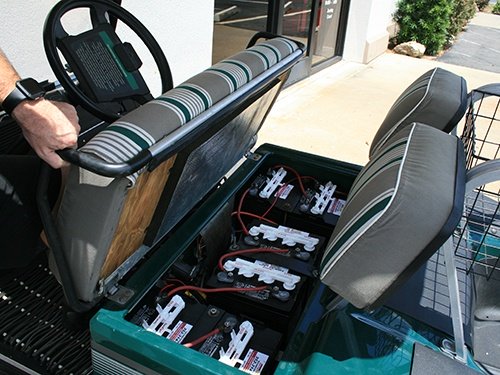
Image Source: jsgolfcarts.com
The Core Factors Guiding Your Golf Cart Battery Setup
Knowing the right number of batteries for your cart is crucial. Getting this wrong can damage your cart’s electronics, limit its range, or prevent it from running at all. This decision hinges on three main things: the cart’s voltage, the type of battery you choose, and how far you plan to drive it.
Grasping Golf Cart Voltage Levels
Electric golf carts run on direct current (DC) power. This power comes from a series of batteries wired together. The total voltage is the sum of the voltage of each individual battery. Standard golf carts typically operate at 36 volts (36V), 48 volts (48V), or sometimes 72 volts (72V).
36 Volt Golf Cart Battery Count
A 36V system is common in older or smaller golf carts. Since most deep-cycle golf cart batteries offer 6 volts (6V) each, you need a specific golf cart battery count to hit this target.
- Calculation: 36 Volts ÷ 6 Volts per battery = 6 batteries.
If you use 8-volt batteries, the math changes:
- Calculation: 36 Volts ÷ 8 Volts per battery = 4.5 batteries. This setup is rare because you cannot use half a battery. Thus, 36V systems almost always use 6V batteries.
48 Volt Golf Cart Battery Count
The 48V system is the most popular choice today. It offers better power and efficiency for most standard-sized carts.
- Using 6V Batteries: 48 Volts ÷ 6 Volts per battery = 8 batteries.
- Using 8V Batteries: 48 Volts ÷ 8 Volts per battery = 6 batteries.
- Using 12V Batteries: 48 Volts ÷ 12 Volts per battery = 4 batteries.
This shows that the golf cart battery voltage and quantity are tightly linked. You must match the voltage of the individual batteries to the total voltage the cart needs.
Golf Cart Battery Requirements: Voltage vs. Amp Hours (Ah)
Voltage tells the cart how fast it can go (power). Amp-hours (Ah) tell you how long it can run (range). While the quantity of batteries sets the voltage, the capacity (Ah) determines performance.
When determining golf cart battery needs, look at both factors. A cart running eight 6V batteries (48V) with 100 Ah each will travel further than one running eight 6V batteries with only 80 Ah each, even though the battery count is the same.
Types of Golf Cart Batteries and Their Impact on Quantity
The chemistry of the battery affects its voltage rating, which directly impacts the golf cart battery configuration.
Flooded Lead-Acid (FLA) Batteries
These are the traditional, workhorse batteries. They typically come in 6V, 8V, or 12V sizes. They are cheap but require regular maintenance, like adding distilled water.
- Common FLA Setups: 6 x 6V (36V) or 6 x 8V (48V).
Sealed Lead-Acid (SLA) Batteries
These are similar to FLA but are sealed and maintenance-free. They are often used in utility carts or backup power systems. They function identically to FLA in terms of voltage configuration.
AGM (Absorbent Glass Mat) Batteries
AGMs are a type of sealed battery. They handle vibration well and can recharge faster than traditional FLA batteries. They come mainly in 12V units, making the golf cart battery setup for a 48V cart very straightforward: four 12V batteries.
Lithium-Ion (Li-ion) Batteries
Lithium batteries are becoming very popular. They weigh much less, last much longer (cycle life), and offer consistent power output until they die. They almost always come in 12V units.
- Lithium Configuration Example: A 48V cart uses four 12V lithium batteries wired in series.
| Battery Type | Typical Voltage per Battery | Common Total Cart Voltage | Typical Golf Cart Battery Count |
|---|---|---|---|
| Lead-Acid (6V) | 6V | 36V | 6 |
| Lead-Acid (8V) | 8V | 48V | 6 |
| Lead-Acid (12V) | 12V | 48V | 4 |
| Lithium-Ion | 12V | 48V | 4 |
Golf Cart Battery Configuration: Series vs. Parallel Wiring
Once you know how many batteries you need, you must know how to connect them. This is the configuration.
Wiring in Series
To increase voltage, you wire batteries in series. This means connecting the positive (+) terminal of one battery to the negative (-) terminal of the next. The amp-hour rating stays the same as the lowest Ah rating in the string.
- Example: Connecting two 12V, 100Ah batteries in series results in 24V, 100Ah.
Wiring in Parallel
To increase capacity (range/Ah), you wire batteries in parallel. This means connecting all positives together and all negatives together. The voltage stays the same as the individual battery voltage, but the Ah rating adds up.
- Example: Connecting two 12V, 100Ah batteries in parallel results in 12V, 200Ah.
The Standard Configuration: Series for Voltage
For a golf cart, the goal is almost always to increase voltage. Therefore, all the batteries in your cart are wired in series to achieve the required 36V or 48V. This explains why the how many deep cycle batteries for golf cart question almost always leads back to achieving the correct total voltage through series wiring.
If you have a 48V cart designed for six 8V batteries, all six are wired in series: 8V + 8V + 8V + 8V + 8V + 8V = 48V.
Advanced Determining Golf Cart Battery Needs: Beyond the Basics
While the voltage standard sets the minimum number, real-world usage often demands more power or range.
Upgrading Voltage for Performance
Some specialized or high-performance carts run at 72V or even higher. These setups require more batteries.
- 72V System Example (using 12V batteries): 72V ÷ 12V = 6 batteries.
- 72V System Example (using 6V batteries): 72V ÷ 6V = 12 batteries.
Adding more batteries (and thus more voltage) generally increases the top speed and torque of the cart, assuming the motor controller can handle the extra power.
Impact of Terrain and Load on Range
The required Ah capacity, and thus how many batteries you need to achieve a certain Ah target, changes based on usage.
- Hilly Terrain: Driving up steep hills demands more current (Amps) from the batteries. This drains them faster, reducing range. If your cart constantly navigates hills, you might need batteries with higher Ah ratings, or potentially a higher voltage system, to compensate.
- Cart Size and Weight: Heavier carts (e.g., 6-seater limousines or utility carts) require more power to move. They need batteries with higher Ah ratings to match the load.
- Accessories: Adding features like large stereos, air conditioning, or winches puts an extra draw on the battery bank, shortening the run time between charges.
If you are replacing an old 48V, 80Ah lead-acid bank with a new one, you might choose a 48V lithium bank rated at 120Ah for significantly better range, even if the quantity of batteries remains four (if using 12V units).
Lithium Conversion: A Shift in Golf Cart Battery Quantity
Switching from lead-acid to lithium drastically alters the physical requirements, though the electrical requirements stay the same.
When swapping a 48V lead-acid bank (eight 6V batteries) to lithium, you switch to four 12V lithium batteries.
| Lead-Acid Setup | Lithium Setup | Change in Quantity | Benefit |
|---|---|---|---|
| 8 batteries (6V each) | 4 batteries (12V each) | Reduced by 4 batteries | Massive weight savings, longer life |
This simplifies the golf cart battery setup physically, as you have fewer heavy components to manage. However, the lithium batteries chosen must have sufficient Ah capacity to meet the power demands that the original eight batteries provided. You must compare the total Ah of the old system to the total Ah of the new system.
- Old Ah Total: 8 batteries * 100 Ah = 800 Ah (at 48V)
- New Ah Total: 4 batteries * 150 Ah = 600 Ah (at 48V)
In this hypothetical comparison, even though the quantity dropped, the range might decrease if the new Ah capacity isn’t high enough. Always match or exceed the previous total Ah rating when upgrading.
Safety and Maintenance Related to How Many Deep Cycle Batteries for Golf Cart
The number of batteries also impacts how you care for them.
Wiring and Series Connection Safety
When wiring batteries in series, you are creating a powerful electrical circuit. Mistakes in wiring can cause sparks, damage the controller, or cause the batteries to overheat.
Crucial Safety Tip: Always disconnect the main negative cable first when servicing the battery bank, and reconnect the main negative cable last.
Charging Considerations
The required battery quantity determines the charger you need. A 36V system needs a 36V charger. A 48V system needs a 48V charger. You cannot use a 36V charger on a 48V bank, or vice versa.
Lithium batteries require specialized lithium chargers that manage cell balancing, which is different from the charging profile used by lead-acid batteries.
FAQ Section
Q1: What voltage is most common for modern golf carts?
The most common voltage for modern golf carts is 48 volts (48V). This offers a good balance of power, speed, and efficiency for general use.
Q2: Can I mix different voltages of batteries in my cart?
No. You must never mix different voltages of batteries in a single bank. Mixing voltages will cause immediate damage to the batteries and likely destroy your cart’s controller. All batteries in the series string must have the exact same voltage rating (e.g., all 6V or all 8V).
Q3: How do I know if my cart is 36 volt or 48 volt?
Check the labeling on your current charger, look at the label near the speed selector switch, or count the batteries. If you have six batteries, it is likely 36V (if they are 6V each). If you have six or eight batteries, it is likely 48V. Always consult your owner’s manual for definitive proof regarding golf cart battery requirements.
Q4: What is the difference between Ah and voltage in my battery bank?
Voltage (V) determines how much power is available to push the cart, affecting top speed and torque. Amp-hours (Ah) determine how much total energy is stored, affecting the distance (range) you can travel before needing a recharge.
Q5: If I buy higher Ah batteries, do I still need the same number of them?
Yes, if you are maintaining the same system voltage (e.g., staying at 48V). The number of batteries is fixed by the voltage needed (e.g., four 12V batteries for 48V). Buying higher Ah batteries only increases the range, not the voltage or the required quantity.