
Have you ever started a woodworking project only to find your cuts are jagged, burnt, or dangerously slow? The secret to a perfect edge isn’t just your skill or your saw—it all comes down to the circular piece of steel spinning at thousands of revolutions per minute. Your blade is the most critical connection between your tool and your lumber.
Choosing the right table saw blade often feels like navigating a maze. With hundreds of options claiming to be the “best,” it is easy to feel overwhelmed by technical jargon like tooth counts, hook angles, and carbide grades. Buying the wrong blade wastes your money, ruins expensive wood, and makes your work feel like a chore rather than a hobby.
In this guide, we will cut through the confusion and help you match the perfect blade to your specific needs. You will learn how to identify the right tooth configuration for your projects and discover which features actually matter for a clean, safe cut. By the end of this post, you will have the confidence to walk into any hardware store and pick the blade that works best for your workshop.
Ready to upgrade your cutting game and achieve professional results every time? Let’s dive into the essential details of table saw blades.
Top Table Saw Blade Recommendations

- For rip and crosscuts. The large gullets allow deep cuts and effective chip clearance.
- Cut solid wood, melamine, laminates, plywood, chipboard. Use on radial arm/miter saws, table saws.
- 0.098 kerf thickness, 0.071 plate thickness, 15° Hook Angle, 1 Flat + 4/20° alternate teeth Grind.
- Micrograin carbide for long-lasting cutting performance and smooth cut on wood/wood products.
- Laser-cut plate features expansion slots to reduce noise and anti-vibration design.

- Shock Resistant Design -azing reinforces carbide tips to withstand high impact, making this blade suitable for demanding jobs.

- Featuring a 10-inch diameter (254 mm), a 5/8-inch arbor (15.88 mm) and a rating of up to 6000 RPM
- Perfect for slicing through both hard and softwoods of all kinds
- Ultra-thin 1/10-inch kerf (2.4 mm) provides clean and efficient cuts
- Designed with 80 carbide-tipped teeth for ultra-fine finish wood cutting
- Compatible with the majority of 10-inch miter saws, jobsite saws, and table saws

- UP TO 3X LIFE*
- Optimized Tooth Geometry Designed For Increased Accuracy
- Ultra Sharp Carbide for Clean Cutting

- 10 Inch Saw Blade for Table Saw/Miter Saw 3 combo pack, 5/8" arbor, 0.098" Kerf(2.5mm), 32T&60T&80T(Tungsten Carbide Tipped), MAX RPM 6,000
- 10 Inch 32T carbide framing & 60T carbide ripping and crosscutting & 80T carbide fine finish table/miter saw blade for cutting hardwoods, softwoods, plywood, melamine, OSB, oak, pine and Nail-Embedded Wood
- Ultra thin kerf design for fast, durable, and clean cuts, requires less cutting power from the user and the saw for better control over the cut.
- Made from C3 grade high-density tungsten carbide for toughness, wear-resistance, and long life. Laser-cut stabilizer vents keep noise and vibration low, giving you precision and control for cleaner cuts.
- Compatible with the vast majority of 5/8" arbor Table/Miter saws on the market. Such as DeWalt, Bosch, Evolution, Makita, Skil, Metabo 10" Table Saw/Miter Saw

- For heavy-duty crosscuts, perfect finishing on single-sided laminated panels.
- For radial arm saws, miter/table & special saws. Cut chipboard, MDF, laminate, hardwood & plywood.
- 0.126 kerf thickness, 0.087 plate thickness, 10° hook angle, Trapezoidal tooth Grind.
- Micrograin carbide teeth to last longer and deliver smooth cuts. Excellent on one-sided laminates.
- Non-Stick PTFE Coating keeps blade running cool, reduces pitch buildup, protects against corrosion.
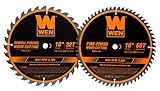
- Featuring both a 32-tooth blade for general woodcutting and a 60-tooth blade for fine-finish woodworking
- Blades measure in at 10-inch diameter (254 mm) with a 5/8-inch arbor (15.88 mm) and a rating of up to 6000 RPM
- Ultra-thin 1/10-inch kerf (2.4 mm) provides clean and efficient cuts
- Perfect for slicing through both hard and softwoods of all kinds
- Compatible with the majority of 10-inch miter saws, jobsite saws, and table saws

- 10 Inch 80-Tooth Ultra Finish Miter / Table Saw Blade, 0.098" Kerf, Wood Cutting with 5/8" Arbor, ATB
- The blades with high-quality thin kerf and plate for fast, durable, smooth cutting, less vibration and noise, and excellent finish
- Made from high-density tungsten carbide for toughness, wear-resistance, and long life
- Compatible with DeWalt, Skil, Metabo, Makita 10 Inch Miter Saws, Table Saws and other Saws
- Ideal for crosscutting oak, pine, melamine, plywood, and moulding.
The Ultimate Table Saw Blade Buying Guide
Choosing the right table saw blade changes how you work. A good blade makes cuts smooth and safe. A bad blade causes burning and kickback. Use this guide to find the perfect match for your saw and your project.
1. Key Features to Look For
First, look at the tooth count. Blades with more teeth create smoother cuts. These are great for finish work. Blades with fewer teeth remove material faster. These are better for ripping long boards.
Next, check the kerf. This is the width of the cut. A thin-kerf blade removes less wood. It puts less strain on your saw motor. A full-kerf blade is thicker and more stable for heavy-duty tasks.
2. Important Materials
Most modern blades use carbide tips. Carbide is very hard and stays sharp for a long time. Steel blades are cheaper but lose their edge quickly. You should always choose carbide-tipped blades for wood projects. Some blades have special coatings to prevent resin buildup. These coatings keep the blade cool and help it move through sticky woods like pine.
3. Factors That Affect Quality
Quality comes down to how the blade is made. Look for laser-cut expansion slots. These slots allow the metal to expand when it gets hot. This prevents the blade from warping during long cuts. You also want a blade with a flat, balanced plate. If the plate is not flat, your cuts will be jagged and uneven.
4. User Experience and Use Cases
Think about what you build. If you make fine furniture, buy a high-tooth-count crosscut blade. If you build decks or framing, buy a general-purpose blade with fewer teeth. Always match your blade to the material. Never use a blade meant for wood on metal or stone. A clean, sharp blade makes your saw feel more powerful and makes your work much safer.
Frequently Asked Questions
Q: How many teeth do I need?
A: Use 24 to 30 teeth for ripping wood. Use 60 to 80 teeth for fine crosscutting or plywood.
Q: What is a “General Purpose” blade?
A: This is a 40-tooth blade. It handles both ripping and crosscutting well. It is the best choice for beginners.
Q: When should I change my blade?
A: Change it if you see burn marks on the wood. Change it if you have to push the wood harder than usual.
Q: Can I sharpen my blade?
A: Yes, professional shops can sharpen carbide blades. However, it is often cheaper to buy a new one for entry-level saws.
Q: What is a “Hook Angle”?
A: It is the angle of the tooth. A high hook angle cuts fast. A low or negative hook angle cuts slower but leaves a smoother edge.
Q: Does blade diameter matter?
A: Yes. Always use the size recommended by your saw manufacturer, usually 10 inches for most home saws.
Q: How do I clean my blade?
A: Use a blade cleaner or a mild degreaser. Scrub the teeth with a soft brush to remove sticky resin.
Q: Why does my wood burn?
A: Your blade might be dull. You might also be feeding the wood too slowly. Keep a steady pace to avoid heat buildup.
Q: What is a “Dado” blade?
A: A dado blade is a special set of blades used to cut wide grooves or slots in wood.
Q: Is a more expensive blade worth it?
A: Yes. Better steel and higher-quality carbide mean the blade stays sharp longer and vibrates less during use.